Fundamentals of Defensive Carbine
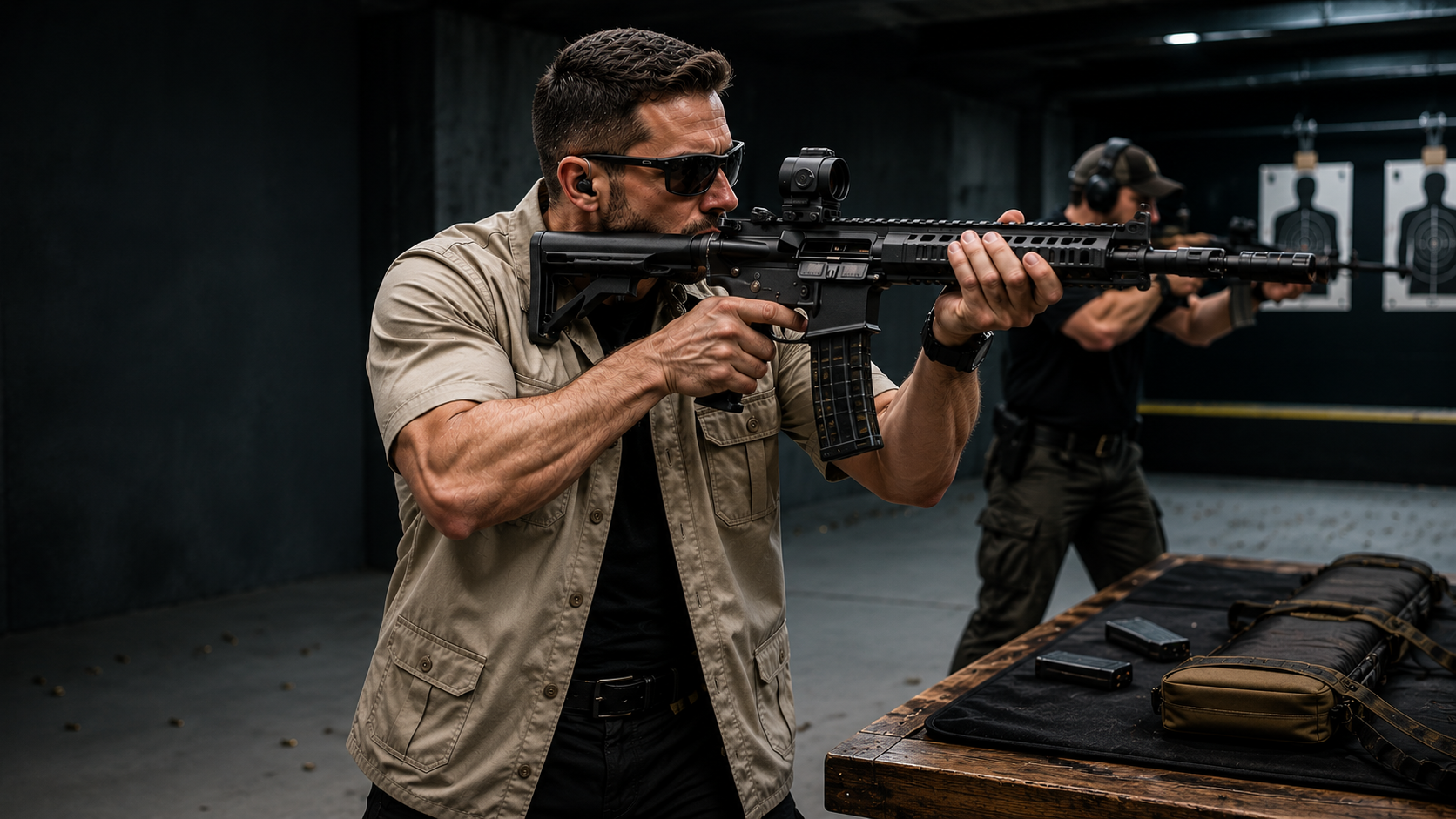
This foundational program introduces new and experienced shooters to the essential principles of safe, effective, and repeatable defensive carbine operation. The course combines classroom instruction, controlled dry-fire practice, and supervised live-fire range application to develop reliable handling and marksmanship.
- Delivery
- On-site
- Duration
- Scheduled on-site
- Assessment
- Practical performance assessment
- Course application
- Apply for this course
What you will learn and demonstrate.
Course Overview
This foundational program introduces new and experienced shooters to the essential principles of safe, effective, and repeatable defensive carbine operation.
The course combines classroom instruction, controlled dry-fire practice, and supervised live-fire range application to develop reliable handling and marksmanship.
The training develops consistent, safe, and repeatable carbine handling through disciplined fundamentals: safe operation, weapon manipulation, stance, grip, chambering a round, and entering shooting position, sight alignment, sight picture, trigger control, breathing, and follow-through.
The central goal is to establish safe handling, technical accuracy, and repeatable performance as the foundation for operational capability.
The programme is delivered using semi-automatic carbine platforms only.
SMART Operational Logic
This programme develops foundational execution capability within the SMART system.
Threat / Risk Context → Weapon Handling Fundamentals → Control Measures (Safe Handling & Marksmanship) → Decision (Controlled Conditions) → Execution → Review / Update
Competency Framework
Firearms capability is defined through demonstrated competencies.
A competency is the ability to:
- make correct decisions
- handle weapons safely and effectively
- apply correct shooting fundamentals
- deliver accurate and controlled fire under controlled conditions
All competencies in this programme are:
- observable
- measurable
- tested under controlled conditions
- validated through performance
Competency is not based on knowledge alone, but on the ability to apply knowledge in execution.
Performance Standards
All operators are evaluated based on:
- safe weapon handling
- control and discipline
- accuracy and consistency
- correct decision-making within controlled conditions
- timing and execution
- compliance with safety procedures
Training Execution Model
Training is conducted within a controlled execution environment designed to develop and validate foundational weapons capability.
All training activities are structured to ensure:
- strict adherence to safety principles
- controlled application of marksmanship fundamentals
- consistent and repeatable weapon handling
- accuracy and discipline in execution
Training progression is controlled and systematic, ensuring that operators develop technical proficiency, control, and reliability before transitioning to advanced operational or scenario-based environments.
Performance Control Conditions
All performance is evaluated under controlled conditions to ensure:
- safety at all times
- precision and consistency of execution
- disciplined application of fundamentals
- measurable performance outcomes
Evaluation focuses on accuracy, control, and adherence to safety standards, ensuring that all performance is reliable, repeatable, and operationally sound.
Training Limitations
This programme is defined as a foundational capability development stage within the ISA-MKD system.
It does not include scenario-based or stress-induced training.
The programme is designed to establish safe handling, control, and technical proficiency, forming the baseline required for progression to operational training where decision-making, pressure, and scenario execution are introduced.
Operational Output
Successful completion confirms that the operator can:
- safely handle carbine platforms
- apply firearm safety rules consistently during all activities
- explain the operating principle and full cycle of operation of a semi-automatic rifle
- perform safe disassembly, inspection, reassembly, and function checks
- zero the carbine and understand mechanical offset and trajectory
- demonstrate correct stance, chambering a round, grip, rifle mounting, and recoil management
- establish consistent sight alignment, sight picture, and trigger control
- present the carbine safely from ready positions and engage targets with control
- conduct safe loading, unloading, and condition checks
- apply dry-fire techniques to reinforce accuracy and weapon manipulation
- execute close-range marksmanship drills (10–50 m) with accuracy and control
- operate within defined safety and legal frameworks
- deliver accurate and controlled fire
- successfully complete a practical handling assessment and live-fire qualification
Performance Review
Conducted continuously throughout training:
- instructor-led feedback and correction
- identification of technical errors
- immediate correction and repetition
- participant self-assessment
Module 1: Safety Rules+
- firearm safety rules
- range etiquette and command compliance
- safe muzzle direction and trigger discipline
- rendering the weapon safe
- training safety rules
- medical brief
Module 2: Operating Principle and Cycle of Operation+
- weapon conditions
- firing cycle explained
- weapon safety manipulation
Module 3: Disassembly and Reassembly+
- field-strip procedures
- component inspection
- preventing assembly errors
Module 4: Function Check+
- post-assembly verification
- dry-fire confirmation process
- cleaning
Module 5: Zeroing the Carbine+
- zeroing the carbine
- mechanical offset considerations
Module 6: Fundamentals of Shooting+
- stance, chambering a round, and body alignment
- grip, stock weld, shoulder pocket
- sight alignment and sight picture
- trigger control and trigger reset
- follow-through and recoil management
Module 7: Dry-Fire Techniques+
- chambering a round and entering standing shooting position
- safety manipulation
- trigger-press isolation
- sight picture stability
Module 8: Weapon Handling and Ready Positions+
- carbine presentation (low and high ready)
- weapon conditions
- loading and unloading
- carry positions
Module 9: Use of Force+
- understand the legal and ethical principles that govern the use of force
- distinguish clearly between non-force options (awareness, avoidance, escape, verbal disengagement) and defensive force
- apply a simple civilian decision model
Module 10: Live-Fire Fundamentals (10–50 m)+
- controlled fire
- shot grouping drills
- trigger-reset practice
- target transitions
Module 11: Final Practical Assessment+
- safe-handling test
- qualification shoot (accuracy and speed)
After-Action Review (AAR)
Conducted at the end of each training block and at the end of the training day:
- Instructor-led evaluation of performance against defined safety and technical standards
- Identification of handling, control, and marksmanship deficiencies
- Immediate correction and demonstration of correct technique
- Structured repetition to establish correct and repeatable execution
- Participant self-assessment focused on safety, control, and consistency
Assessment
This programme applies a continuous competency-based performance validation system.
- safe-handling test (procedural safety compliance)
- live-fire qualification (accuracy and shooting performance)
- weapon control evaluation (continuous handling discipline and control)
Standard: Competent / Not Competent
Operators must pass:
safe handling test
live-fire qualification shoot (10–50 m)
Failure Policy:
- fail 1 component → remedial instruction and re-test
- fail 2 components → full course re-take
- unsafe handling → immediate removal
Retake
If a participant does not pass the course:
- The participant is permitted to retake the course without an additional course fee
- The participant must restart and complete all required training components from the beginning
Retake eligibility is granted to support capability development and does not guarantee successful certification. Competence must be demonstrated under the same assessment conditions.
Retake Requirements
- All training modules and practical sessions must be re-attended
- All practical exercises and scenario-based assessments must be completed
- Final evaluation must meet ISA-MKD Competent grading standards
Certification
Certification confirms that the operator has demonstrated safe handling, accuracy, and controlled execution in accordance with ISA-MKD performance standards.
Certificate of Competence: Defensive Carbine Operator (Foundation Level)
Target Participants
- individuals seeking safe and structured firearms training
- beginners with no prior experience
- licensed firearm owners improving handling and accuracy
- professionals requiring foundational weapons capability
Firearm Requirements
A carbine is provided for the duration of the course. Participants with a valid licence may use their personal firearm, subject to inspection and range compliance rules.
Includes:
- full-day structured training programme
- 100 rounds
- qualification-based assessment
- certification
- weapon
Need help choosing the right training?
Tell us the role, capability, or operational requirement you need to address.
Apply for this course.
Submit your course selection and applicant details. Supporting documents are requested separately after review.
Need this capability across an organization or public-service unit?
We adapt course scope, scenarios, delivery, and assessment to your staff, mandate, and operating environment.