Cultural Behaviour & Interaction in Middle East Operations
This course defines the operational capability to apply culturally appropriate behaviour, communication, and interaction in Middle East environments in order to support security operations, coordination, and decision-making under real-world conditions. The course develops the ability to interpret cultural context, adapt behaviour based on hierarchy…
- Delivery
- On-site
- Duration
- Scheduled on-site
- Assessment
- Practical performance assessment
- Course application
- Apply for this course
What you will learn and demonstrate.
Course Overview
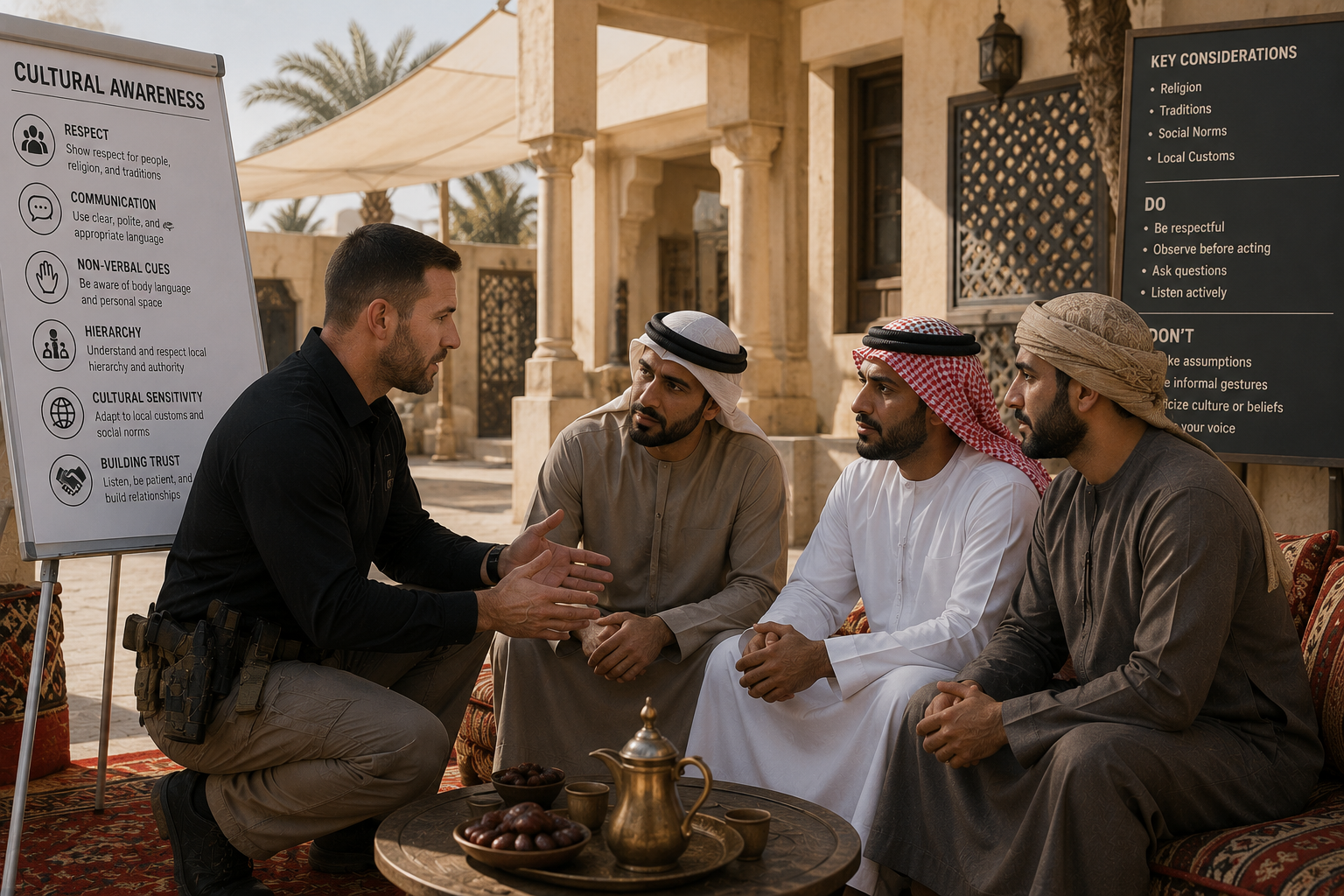
This course defines the operational capability to apply culturally appropriate behaviour, communication, and interaction in Middle East environments in order to support security operations, coordination, and decision-making under real-world conditions.
The course develops the ability to interpret cultural context, adapt behaviour based on hierarchy and social dynamics, manage communication in high-context environments, and prevent escalation through culturally informed interaction. The system focuses on behaviour as an operational variable that directly affects access, trust, cooperation, and risk.
Misinterpretation, inappropriate conduct, or failure to adapt communication can lead to operational friction, loss of access, escalation, or mission failure.
The course enables participants to function effectively in culturally complex environments by applying structured behavioural awareness, communication discipline, and interaction control aligned with operational objectives, threat context, and acceptable risk, and applying correct behaviour before escalation reaches operational or crisis conditions.
Operational Doctrine Behaviour and communication are treated as operational variables that directly influence access, cooperation, escalation, and risk.
All behavioural decisions must remain aligned with operational objectives, threat context, and acceptable risk.
SMART Operational Logic Behavioural decisions are derived from assessed operational context and must support threat mitigation, risk control, and mission continuity.
Operational Context → Cultural Interpretation → Behavioural Control Measures → Decision → Interaction Execution → Outcome → Risk Impact → Adjustment → Review / Update
Competency Framework
Cultural capability at the operational level is defined through the operator’s ability to apply behaviour, communication, and interaction in a way that supports operational objectives and prevents escalation.
A competency is the ability to:
- apply culturally appropriate behaviour in operational environments
- adapt communication to high-context cultural settings
- manage interaction based on hierarchy and relationship dynamics
- prevent escalation through behavioural awareness
- interpret social signals and implied meaning
- operate effectively in culturally sensitive environments
- maintain professionalism under culturally complex conditions
- support decision-making through correct behavioural judgement
Performance Standards
Situational Awareness
- recognize behavioural indicators linked to tension, threat, or escalation risk
- interpret social dynamics correctly
Decision-Making
- apply culturally appropriate responses in real-time situations
- prevent escalation through correct behaviour and communication
- maintain behaviour aligned with operational objectives and acceptable risk
Module 1: Regional Context & Identity+
Purpose Understand identity, diversity, and terminology within operational environments
Learning Outcomes
- apply correct terminology for identity groups
- recognize diversity and avoid stereotyping
- use respectful forms of address
Key Exercises
- classify identity scenarios
- correct inappropriate introductions
Module 2: Cultural Foundations+
Purpose Understand core cultural behaviour patterns influencing operational interaction
Learning Outcomes
- identify collectivist and hierarchical norms
- interpret indirect communication
- adjust expectations for decision-making
Key Exercises
- decode communication scenarios
- map hierarchy influence
Module 3: Honour, Dignity & Hospitality+
Purpose Apply behaviour that preserves dignity, maintains access, and prevents escalation in operational environments
Learning Outcomes
- demonstrate correct greeting and hosting behaviour
- identify dignity-sensitive actions
- manage invitations and obligations
Key Exercises
- identify dignity risks
- structure hosting interactions
Module 4: Islam as a Cultural System+
Purpose Understand religious influence on behaviour within operational context
Learning Outcomes
- coordinate activities around religious practices
- apply appropriate behaviour during Ramadan
- operate correctly in public environments
Key Exercises
- build culturally appropriate schedules
- adapt planning to religious context
Module 5: Sunni & Shia Cultural Orientation+
Purpose Understand sect-related sensitivities affecting interaction, perception, and potential escalation
Learning Outcomes
- recognize cultural indicators linked to sect identity
- respond appropriately to practices
- avoid escalation triggers
Key Exercises
- analyse mixed-sect scenarios
- identify sensitive behaviours
Module 6: Communication & Interaction Style+
Purpose Apply controlled communication to support operational interaction, prevent escalation, and maintain clarity in sensitive situations
Learning Outcomes
- apply indirect communication
- interpret tone and implied meaning
- manage disagreement appropriately
- maintain communication discipline
- avoid escalation through communication behaviour
Key Exercises
- rewrite communication
- analyse dialogue
- respond to sensitive and escalating interaction scenarios
Module 7: Business, Leadership & Negotiation+
Purpose Operate effectively within professional and hierarchical environments while maintaining control of interaction and decision influence
Learning Outcomes
- build trust-based relationships
- navigate hierarchy
- manage negotiation timing
Key Exercises
- map negotiation structures
- define engagement pathways
Module 8: Regional Behavioural Variations+
Purpose Adapt behaviour across different regional environments
Learning Outcomes
- adjust communication based on region
- apply appropriate formality
- adapt behaviour to environment
- recognize behavioural differences that may influence perception or escalation
Key Exercises
- compare regional behaviour
- select correct communication
Module 9: Arabic Survival Language+
Purpose Enable basic operational communication capability
Learning Outcomes
- apply essential Arabic phrases
- communicate in basic operational scenarios
- use tone and delivery effectively
Key Exercises
- practice dialogue scenarios
- match phrases to situations
Module 10: Radicalization Awareness & Behavioural Risk+
Purpose Provide situational awareness of radicalization as a behavioural process and enable identification of risk indicators while maintaining neutral, professional, and non-escalatory conduct in operational environments
Learning Outcomes
- understand radicalization as a process, not identity
- distinguish belief, religion, and violent extremist ideology
- understand drivers of radicalization (social, political, psychological)
- recognize behavioural and narrative indicators
- avoid actions that escalate tension
- apply neutral, professional response
- maintain cultural respect while preserving security
- identify behavioural indicators relevant to operational risk and escalation
- support appropriate reporting and escalation decisions
- apply behavioural judgement aligned with operational context
Key Exercises
- identify behavioural risk indicators in scenarios
- distinguish belief expression vs risk behaviour
- analyse escalation caused by communication errors
- practice neutral, non-provocative responses
- respond to escalating behavioural scenarios in controlled conditions
- select appropriate escalation and reporting actions
After-Action Review (AAR)
- instructor-led feedback
- identification of errors
- behavioural correction
- participant self-assessment
Final Assessment
The participant must demonstrate the ability to successfully complete:
- scenario-based interaction evaluation
- cultural decision-making assessment
- behavioural response evaluation
Retake
If a participant does not pass the course:
- The participant is permitted to retake the course without an additional course fee
- The participant must restart and complete all required training components from the beginning
Retake eligibility is granted to support capability development and does not guarantee successful certification. Competence must be demonstrated under the same assessment conditions.
Retake Requirements
- All training modules and practical sessions must be re-attended
- All practical exercises and scenario-based assessments must be completed
- Final evaluation must meet ISA-MKD Competent grading standards
Certification
Certification Standard: Competent / Not Competent
The operator receives: Certified Cultural Behaviour & Interaction – Middle East Operations
Includes:
- 2 days training delivery
- participant handbook
- Arabic survival language sheet
- cultural communication reference material
Need help choosing the right training?
Tell us the role, capability, or operational requirement you need to address.
Apply for this course.
Submit your course selection and applicant details. Supporting documents are requested separately after review.
Need this capability across an organization or public-service unit?
We adapt course scope, scenarios, delivery, and assessment to your staff, mandate, and operating environment.