Advanced Defensive Carbine
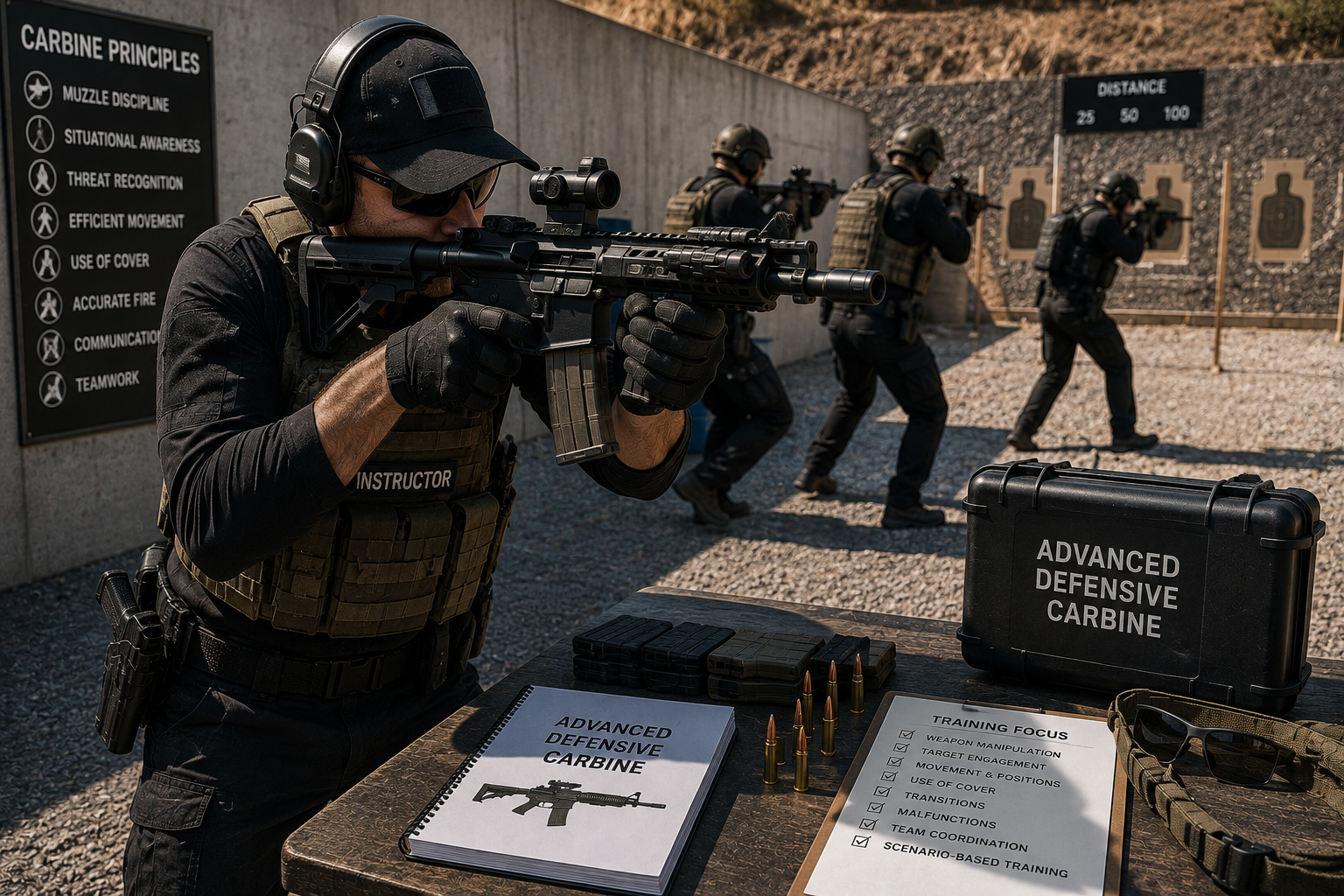
This advanced program builds on the Fundamentals of Defensive Carbine course and develops the operator’s ability to maintain continuous weapon control, situational awareness, and decision-making under stress. The training focuses on efficient weapon manipulation, target engagement, movement, use of cover, transitions, and team coordination…
- Delivery
- On-site
- Duration
- Scheduled on-site
- Assessment
- Practical performance assessment
- Course application
- Apply for this course
What you will learn and demonstrate.
Course Overview
This advanced program builds on the Fundamentals of Defensive Carbine course and develops the operator’s ability to maintain continuous weapon control, situational awareness, and decision-making under stress.
The training focuses on efficient weapon manipulation, target engagement, movement, use of cover, transitions, and team coordination in dynamic and unpredictable environments.
The course integrates individual performance with tactical application, ensuring the operator can function effectively in real-world conditions, both independently and as part of a team.
The training is built on the core pillars:
- Efficiency
- Accuracy
- Consistency
- Situational Awareness
- Self-Control Under Stress
The programme is delivered using semi-automatic carbine platforms only.
SMART Operational Logic
This programme develops advanced execution capability within the ISA-MKD system under stress and scenario-based conditions.
Threat / Risk Context → Control Measures → Decision → Execution Under Stress → Performance → Review / Update
Competency Framework
Firearms capability at the advanced level is defined through the operator’s ability to execute safely, accurately, and consistently under pressure in dynamic and scenario-based environments.
A competency is the ability to:
- maintain continuous weapon control under stress
- apply shooting fundamentals under time pressure
- integrate movement, positioning, and environment
- perform reloads, transitions, and malfunction management in dynamic conditions
- maintain situational awareness during all actions
- operate effectively within a team environment
- apply communication discipline during movement and engagement
- apply decision-making in scenario-based exercises
All competencies in this programme are:
- observable
- measurable
- tested under time pressure and dynamic conditions
- validated through scenario-based performance
Competency is defined by execution under pressure, not knowledge alone.
Performance Standards
Operators must demonstrate performance aligned with the defined competency pillars under time pressure and in scenario-based conditions.
Performance is evaluated across the following domains:
Safety and Control
- safe weapon handling at all times
- continuous weapon functionality and control
Accuracy and Consistency
- minimum 80% accuracy under time pressure
- consistent shot placement during dynamic drills
Weapon Manipulation
- correct application of reloads and transitions
- effective malfunction identification and resolution under pressure
Movement and Positioning
- safe and controlled movement with weapon
- correct use of cover and positioning
Situational Awareness
- awareness during all manipulations
- continuous observation of environment and threat indicators
Decision-Making
- effective decision-making in all scenario-based exercises
- correct application of force within training scenarios
Training Execution Model
Training is conducted through a structured progression from technical execution to performance under stress and full scenario-based operational application.
All training activities are designed to develop and validate operator capability across the defined performance pillars: efficiency, accuracy, consistency, situational awareness, and self-control under stress.
Training is delivered through three progressive phases:
Phase 1: Technical Reinforcement • refinement of shooting fundamentals under controlled conditions • development of efficient weapon manipulation (reloads, transitions, malfunctions) • establishment of consistency in shooting platform and control+
Phase 2: Controlled Stress Application • introduction of time pressure and performance constraints • integration of movement, positioning, and use of cover • application of reloads and transitions under pressure • integration of team coordination drills+
Phase 3: Scenario-Based Operational Training • application of all skills in dynamic and unpredictable environments • integration of decision-making under stress • execution of individual and team-based scenario exercises+
Training is continuous and performance-driven, with:
- immediate instructor feedback
- repetition under increasing complexity
- correction of errors in real time
Training progression ensures that operators transition from isolated skill execution to full operational performance under pressure.
Performance Control Conditions
All performance is evaluated under controlled but progressively demanding conditions to ensure safe, measurable, and repeatable execution under stress and in scenario-based environments.
Performance evaluation is conducted under the following conditions:
Safety Conditions
- strict adherence to firearm safety rules at all times
- continuous instructor supervision during all drills and scenarios
- immediate intervention in case of unsafe handling
Time Pressure Conditions
- execution of drills within defined time limits
- performance degradation monitored under increasing speed requirements
- decision-making evaluated under compressed timeframes
Movement and Environment Conditions
- execution of drills while moving (forward, backward, lateral)
- use of cover, barricades, and positional shooting
- adaptation to dynamic and changing environments
Weapon Manipulation Conditions
- reloads and transitions performed under time pressure and movement
- malfunction resolution executed under stress
- weapon handling under dynamic conditions
Scenario-Based Conditions
- integration of full skill sets in realistic scenarios
- decision-making under stress and uncertainty
- threat identification and response evaluation
- team coordination and communication under pressure
Performance is assessed based on:
- consistency of execution
- control under pressure
- accuracy within defined standards
- correct application of techniques
- situational awareness and decision-making
Training Limitations
This programme is conducted within a controlled training environment with structured exposure to stress and scenario-based conditions.
All training activities are executed under strict safety protocols and continuous instructor supervision.
While the programme introduces time pressure, movement, and scenario-based exercises, all conditions remain controlled and regulated to ensure safe execution and measurable performance.
The training environment is designed to simulate dynamic and unpredictable situations; however, it does not replicate real-world operational deployment conditions.
The programme is limited to capability development within defined safety, legal, and training parameters.
Operational Output
Successful completion of this programme confirms that the operator can perform safely, accurately, and consistently under stress in dynamic and scenario-based environments.
The operator is able to:
- maintain continuous weapon control under stress
- maintain weapon status awareness at all times
- execute admin, combat, and tactical reloads correctly
- apply working space position without losing environmental awareness
- understand and apply POA vs POI across distances and shooting positions
- identify and respond to malfunctions under stress
- engage multiple targets with control and discipline
- react to threats from all directions
- use cover effectively in dynamic environments
- move safely and efficiently with the weapon
- operate effectively in team environments with communication discipline
- apply use-of-force decisions in complex scenarios
- perform in full scenario-based operational environments
- integrate all skills into operational performance
Module 1: Admin Reload and Weapon Preparation System+
Purpose Establish complete control over weapon readiness and configuration before engagement.
Takeaways
- Admin reload, chambering a round and verification methods
- Magazine placement on belt or vest for consistency and access
- Weapon placement in working space
- Prone position fundamentals (low profile, stability)
- Zeroing sequence (mechanical to optic to confirmation)
Module 2: Shooting Platform and Control System+
Purpose Develop stable, repeatable shooting platforms across all positions.
Takeaways
- Standing, kneeling, urban prone, prone
- Squatting and supine application
- Weapon-hands positioning
- Weapon safety manipulation
- Scan, assess and re-engage discipline
Module 3: Weapon Manipulation and Reload System+
Purpose Maintain weapon continuity during all phases of engagement.
Takeaways
- POA vs POI understanding
- Working space principle
- Combat reload vs tactical reload decision logic
- Transitions (primary to secondary)
- Shoulder transitions (left and right adaptation)
Module 4: Malfunction Management System+
Purpose Maintain operational capability during weapon failure.
Takeaways
- Identify malfunction before action
- Apply correct response under control
- Maintain awareness while resolving the malfunction
Module 5: Multiple Target Engagement System+
Purpose Develop control when engaging multiple threats.
Takeaways
- Target prioritization
- Controlled transitions between targets
- Maintain awareness between engagements
Module 6: Reaction and Turning System+
Purpose Respond effectively to threats from all directions (static and dynamic).
Takeaways
- Turning sequence
- Maintain control during rotation
- Weapon safety control during directional changes
Module 7: Cover Utilization System (Barricades and Vehicles)+
Purpose Use environment for protection and tactical advantage.
Takeaways
- Barricade use
- Open corners
- Vehicle as cover concept
- Position adaptation based on environment
Module 8: Movement and Team Coordination System+
Purpose Operate safely and effectively in dynamic environments and working in a team.
Takeaways
- Moving and shooting with weapon control
- Running with weapon and breaks
- Maintain situational awareness in dynamic environments
- Team communication discipline
- Team positioning and spacing awareness
Module 9: Scenario-Based Operational Training+
Purpose Integrate all skills into realistic environments.
Takeaways
- apply decision-making under stress
- identify threats
- apply full system integration
After-Action Review (AAR)
Conducted at the end of each training day:
- Instructor-led feedback
- Identification of errors
- Correction and improvement
- Participant self-assessment
Final Assessment
The operator must demonstrate the ability to successfully complete:
- Timed speed reload evaluation
- Movement and engagement test
- Malfunction resolution under stress
- Scenario-based operational evaluation
- Decision-making assessment
Failure to Meet the Standard
All modules are assessed against performance criteria.
- Failure of two or more modules = course re-take
- Failure of one module = remedial instruction and three re-assessment attempts is permitted.
- Unsafe conduct = immediate removal pending review
Retake
If a participant does not pass the course:
- The participant is permitted to retake the course without an additional course fee
- The participant must restart and complete all required training components from the beginning
Retake eligibility is granted to support capability development and does not guarantee successful certification. Competence must be demonstrated under the same assessment conditions.
Retake Requirements
- All training modules and practical sessions must be re-attended
- All practical exercises and scenario-based assessments must be completed
- Final evaluation must meet ISA-MKD Competent grading standards
Certification
Certification Standard: Competent / Not Competent
The operator receives: Certified Advanced Defensive Carbine Operator
Includes:
- 3 Days training delivery
- 300 rounds
- Scenario-based training test
- Certification
- Weapon
Need help choosing the right training?
Tell us the role, capability, or operational requirement you need to address.
Apply for this course.
Submit your course selection and applicant details. Supporting documents are requested separately after review.
Need this capability across an organization or public-service unit?
We adapt course scope, scenarios, delivery, and assessment to your staff, mandate, and operating environment.