Civilian Active Shooter / Active Assailant Preparedness & Response
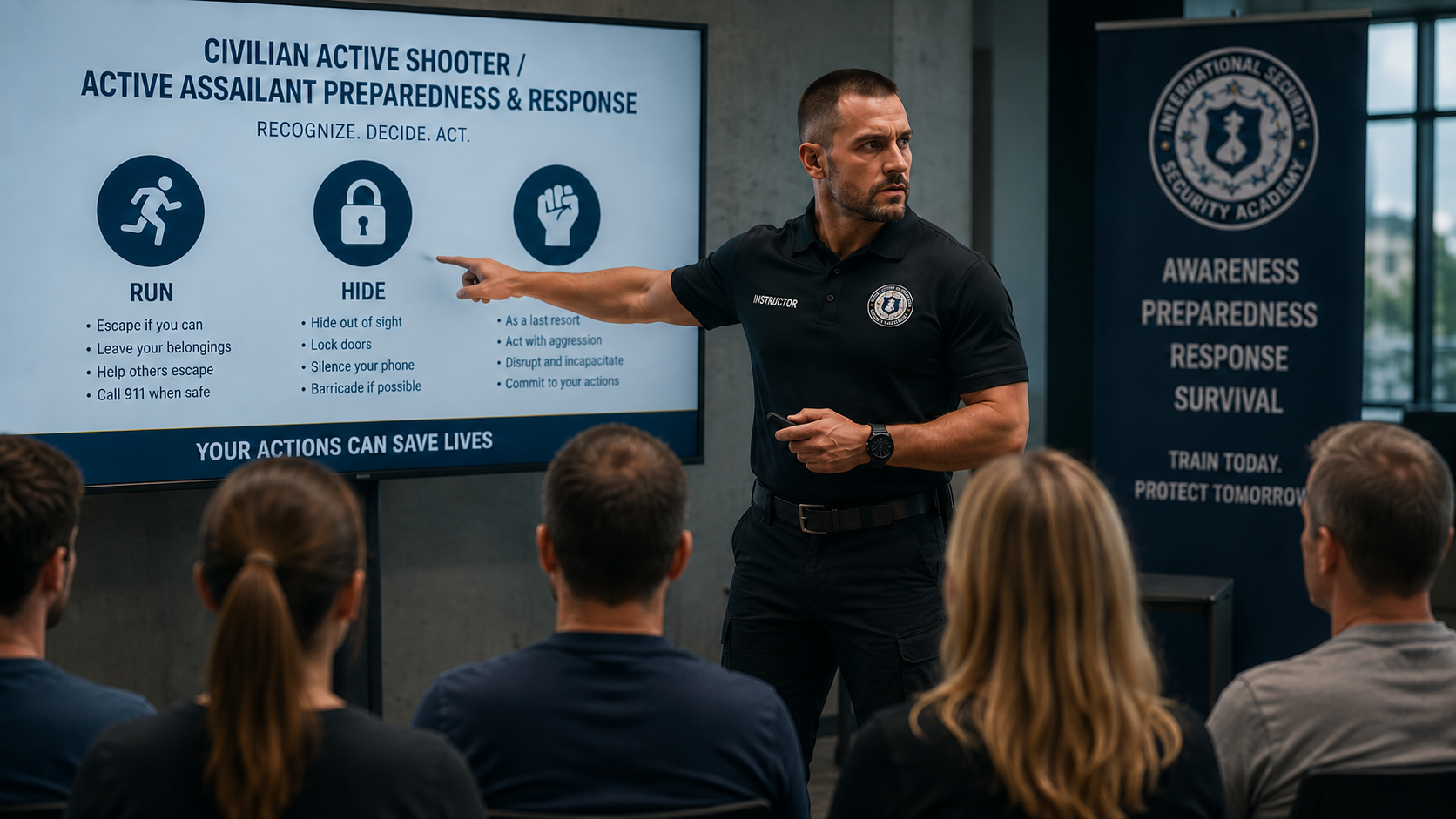
Free civilian awareness training covering how to recognize warning signs and immediate danger, select safer response options, communicate essential information to emergency services, and identify immediate lifesaving actions that may be taken when it is safe to help.
- Delivery
- Online
- Duration
- Self-paced online study
- Assessment
- Scenario-Based Decision Assessment
- Free course access
- Start the free course

What you will learn and demonstrate.
Understand stress reactions, recognise danger, and choose when to escape, hide, deny access, or defend as a last resort. Learn how to alert emergency services, respond safely to police, control severe bleeding when safe, and support vulnerable people. Demonstrate this understanding through seven realistic incident scenarios.
10 guided modules: what to expect
Work through the subjects in order, from recognizing stress and warning signs to choosing safer actions and supporting an emergency response. 7 modules include a scenario-based decision check.
-
Course introduction
This course is designed to improve civilian awareness, preparedness, and survival decision-making during active shooter or active assailant incidents.
-
Human Reactions Under Extreme Stress
This module explains how people may react physically and mentally during an active shooter or active assailant incident.
-
Situational Awareness and Prevention
Scenario checkThis module explains how situational awareness supports prevention and early response during an active shooter threat. Situational awareness is not paranoia. It is the ability to notice what…
-
Run and Escape During an Active Shooter Incident
Scenario checkThis module explains when and how to escape during an active shooter incident. The objective of escape is to move away from immediate danger, create distance from the…
-
Calling the Police and Providing Information
Scenario checkThis module explains when and how to call the police during an active shooter incident and what information should be provided to emergency dispatchers.
-
Hide and Deny Access During an Active Shooter Incident
Scenario checkThis module explains when and how to hide during an active shooter incident when escape is not safe or not possible.
-
Defend as a Last Resort
Scenario checkThis module explains what to do if escape is not possible, hiding has failed, and the attacker reaches your location.
-
Police Arrival and Civilian Safety
Scenario checkThis module explains how civilians should behave when law enforcement arrives during or after an active shooter incident.
-
Immediate Lifesaving Actions and Bleeding Control
Scenario checkThis module explains basic immediate lifesaving actions that may be required during an active shooter incident when someone is injured and professional medical help has not yet reached…
-
Special Considerations for Vulnerable Persons
During an active shooter or active assailant incident, not all civilians will react, move, hear, see, or process information in the same way.
Need help choosing the right training?
Tell us the role, capability, or operational requirement you need to address.
Need this capability across an organization or public-service unit?
We adapt course scope, scenarios, delivery, and assessment to your staff, mandate, and operating environment.