Counter-Terrorism (CT) Strategy
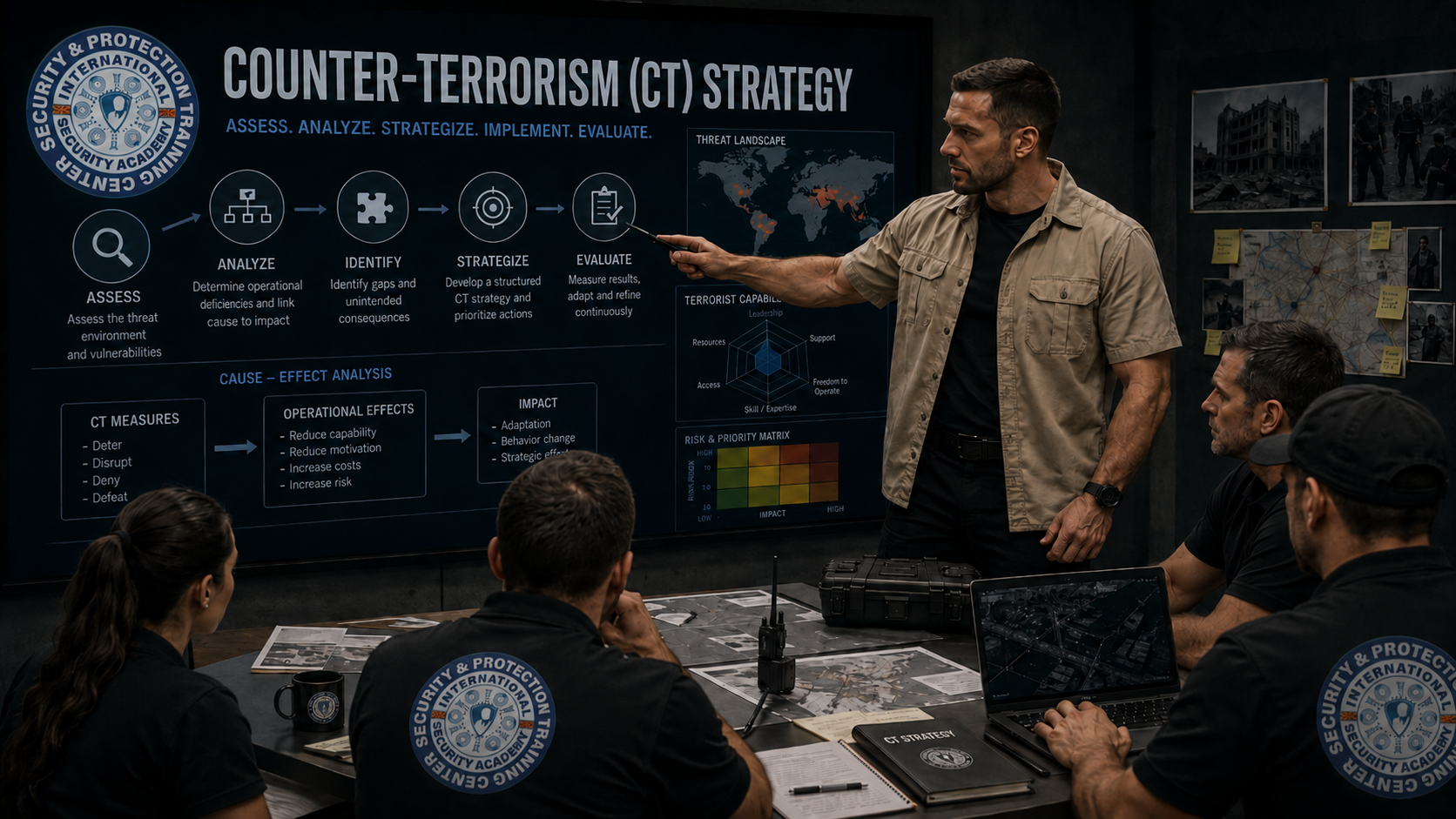
Counter-Terrorism (CT) Strategy defines the process of assessing CT measures, determining operational effects, identifying gaps and unintended consequences, and producing a structured CT strategy. CT evaluation is executed through cause–effect analysis linking measures to impact on terrorist capability, motivation, and adaptation. All outputs are…
- Delivery
- Online
- Duration
- Self-paced online
- Assessment
- Scenario-based assessment
- Course application
- Apply for this course
What you will learn and demonstrate.
Course Overview
Counter-Terrorism (CT) Strategy defines the process of assessing CT measures, determining operational effects, identifying gaps and unintended consequences, and producing a structured CT strategy.
CT evaluation is executed through cause–effect analysis linking measures to impact on terrorist capability, motivation, and adaptation. All outputs are evidence-based, traceable, and aligned with operational conditions.
The final output is a decision-ready CT strategy supporting leadership, planning, and operational execution.
Each module progressively builds toward the final CT Strategy output, ensuring full traceability from threat assessment to operational decision-making.
Capability Development Chain
Threat Profile (Layer 1) → Operational Risk Scenarios (Layer 2) → CT Measures → Effects → Consequences → Adaptation → Strategy Output → Risk Reduction Objectives
Participants must
- Assess CT measures
- Determine operational effects
- Identify gaps, failures, and unintended consequences
- Assess impact on terrorist capability and motivation
- Determine adversary adaptation
- Produce layered CT strategy
- Deliver a traceable and defensible output
Key Concepts
- Assess CT measures based on their operational effects on terrorist capability, motivation, and behaviour
- Determine whether CT measures produce desired outcomes or create unintended and counterproductive effects
- Evaluate CT effectiveness using structured cause–effect logic (measure → effect → consequence → adaptation)
- Identify gaps, failures, and weaknesses in CT measures using evidence-based analysis
- Determine whether CT measures reduce, shift, or increase threat
- Assess second-order and unintended consequences of CT actions on the operational environment
- Identify adversary adaptation patterns driven by CT pressure
- Assess how hybrid terrorist structures affect capability, resilience, and vulnerability
- Identify indicators across planning and preparation phases to determine detection opportunities
- Distinguish between organized and lone-actor threats to define appropriate CT response
- Evaluate CT measures against operational conditions, feasibility, and proportionality
- Assess the impact of CT actions on public perception, behaviour, and operational stability
- Identify risks of escalation, overreaction, and loss of control resulting from CT actions
- Determine whether CT actions support or undermine long-term security objectives
- Apply defence-in-depth through layered CT measures (prevent, detect, disrupt, respond)
- Distinguish prevention measures from mitigation measures in CT strategy
- Produce layered CT strategy aligned with identified vulnerabilities and threat behaviour
- Ensure all CT outputs are evidence-based, traceable, and defensible
MODULE 1: WHAT IS TERRORISM+
Purpose
Establish operational classification criteria for terrorism to support CT decision-making.
Learning Outcomes
- Classify incidents as terrorism based on defined criteria
- Distinguish terrorism from crime, insurgency, and political violence
- Identify terrorist actor structure and operational components
- Determine terrorist capability and operating conditions
- Identify targeting patterns and attack objectives
- Determine relevance of terrorism classification to CT measures
Key Exercises
- Incident classification exercise
- Terrorism vs crime / insurgency comparison exercise
- Terrorist actor structure mapping exercise
- Targeting pattern analysis exercise
- Attack objective identification exercise
MODULE 2: WHAT IS COUNTER-TERRORISM+
Purpose
Assess Counter-Terrorism measures based on effectiveness and operational consequences.
Learning Outcomes
- Identify CT measures as offensive, defensive, or punitive
- Assess effectiveness of CT measures
- Determine second-order consequences of CT actions
- Assess CT impact on terrorist capability
- Assess CT impact on terrorist motivation
- Identify ineffective or counterproductive CT measures
- Determine CT measure suitability to operational conditions
Key Exercises
- CT measures classification exercise
- CT measure effectiveness assessment exercise
- Cause–effect analysis exercise
- Second-order consequences identification exercise
- Counterproductive measure identification exercise
MODULE 3: HYBRID TERRORIST ORGANIZATIONS+
Purpose
Assess hybrid terrorist organizations as operational systems affecting CT effectiveness.
Learning Outcomes
- Identify hybrid structures combining political, military, and social components
- Determine functional roles of each component
- Assess terrorist capability derived from hybrid structure
- Identify support systems and enabling conditions
- Determine vulnerabilities created by hybrid organization structure
- Assess impact of hybrid structure on CT effectiveness
Key Exercises
- Hybrid organization structure mapping exercise
- Functional component analysis exercise
- Support system identification exercise
- Capability and vulnerability assessment exercise
- CT pressure vs hybrid resilience analysis exercise
MODULE 4: RATIONALE OF HYBRID ORGANIZATIONS & ATTACK SELECTION+
Purpose
Determine how terrorist actors select and adapt attacks based on CT measures.
Learning Outcomes
- Determine variables influencing attack selection based on CT pressure
- Determine cost–benefit logic of attack methods
- Identify indicators across planning and preparation phases
- Assess CT impact on attack adaptation
- Distinguish organized and lone-actor attack models
- Determine likely future attack patterns
Key Exercises
- Attack selection logic analysis exercise
- Planning and preparation indicators exercise
- Organized vs lone-actor comparison exercise
- CT pressure and attack adaptation exercise
- Future attack pattern projection exercise
MODULE 5: MEDIA, PUBLIC OPINION & PSYCHOLOGICAL RESILIENCE+
Purpose
Assess the effect of CT actions on perception, behaviour, and operational stability.
Learning Outcomes
- Identify psychological objectives of terrorism
- Assess media impact on CT effectiveness
- Determine effect of communication on public behaviour
- Assess CT impact on terrorist motivation through public response
- Identify risks of uncontrolled or fear-driven reaction
- Determine communication measures supporting operational stability
Key Exercises
- Media effect assessment exercise
- Public reaction and behavioural impact exercise
- Psychological objective analysis exercise
- CT communication failure exercise
- Operational communication response exercise
MODULE 6: FINAL OPERATIONAL SCENARIO+
Purpose
Validate full operational capability to assess effectiveness of CT measures and produce a justified CT strategy.
Scenario Requirements
Participants must
- Assess CT measures (offensive, defensive, punitive)
- Evaluate effectiveness of CT measures against terrorist behaviour
- Identify gaps, failures, and unintended consequences
- Assess impact on:
- Terrorist capability
- Terrorist motivation
- Map cause–effect relationships (measure → effect → adaptation)
- Determine whether CT approach is:
- Effective
- Partially effective
- Counterproductive
- Produce CT strategy using layered measures
- Deliver leadership briefing
Assessment Requirements
- Written CT measures effectiveness analysis (structured, evidence-based, traceable)
- CT Strategy document (layered, justified, aligned to operational conditions)
- Final Operational Scenario performance evaluation (decision-making, analysis, justification)
- Leadership briefing (clarity, justification, operational relevance, defensibility)
Need help choosing the right training?
Tell us the role, capability, or operational requirement you need to address.
Apply for this course.
Submit your course selection and applicant details. Supporting documents are requested separately after review.
Need this capability across an organization or public-service unit?
We adapt course scope, scenarios, delivery, and assessment to your staff, mandate, and operating environment.