Close Protection Officer
The Close Protection Officer Course is designed to develop, assess, and certify operational capability in operators to deliver effective close protection for designated officials, public figures, and individuals requiring protective security, ensuring measurable performance in execution, decision-making, and professional conduct under operational conditions.

- Delivery
- On-site
- Duration
- Scheduled on-site
- Assessment
- Practical performance assessment
- Course application
- Apply for this course
What you will learn and demonstrate.
Mission
The Close Protection Officer Course is designed to develop, assess, and certify operational capability in operators to deliver effective close protection for designated officials, public figures, and individuals requiring protective security, ensuring measurable performance in execution, decision-making, and professional conduct under operational conditions.
Training Objective
This curriculum is designed to develop the operational capability required to perform effectively as a Single Operative Close Protection Officer and as part of a protection team in real-world operational environments, delivering protective security for designated officials, public figures, and other protected individuals.
Operational Doctrine
Close Protection operations are conducted using a prevention-focused and risk-based approach.
All protective actions are guided by:
Prevention over reaction
Early threat detection
Control of time, distance, and positioning
Layered protection
Continuous situational awareness
Lawful, necessary, and proportionate use of force
Principal safety as the overriding priority
The course operates as the execution layer of the SMART system, linking Threat assessment, Risk evaluation, and operational execution into one continuous system.
SMART Operational Logic All actions, decisions, and procedures are derived from structured analysis of Threat, Risk, and operational conditions. Execution is based on defined Control Measures and must remain proportionate, justified, and traceable.
Threat → Risk → Control Measures → Decision → Execution → Review / Update
Competency Framework
Close Protection capability is defined through demonstrated competencies.
A competency is the ability to:
- make correct decisions
- execute tasks effectively
- apply appropriate behaviour
- deliver operational outcomes
under realistic conditions.
All competencies in this course are:
- observable
- measurable
- tested under pressure
- validated through performance
Competency is not based on knowledge alone, but on the ability to apply knowledge in execution.
Performance Standards
All trainees are evaluated based on:
- Decision-making under pressure
- Execution accuracy
- Timing and response speed
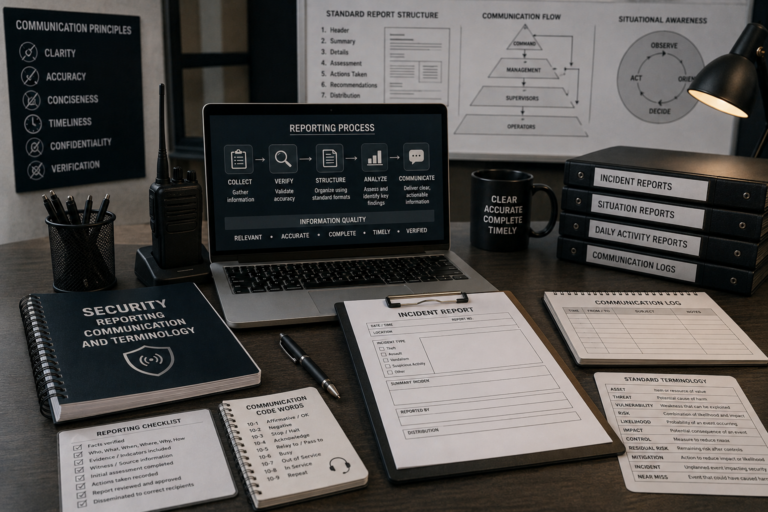
- Communication and coordination
- Discipline and control
- Outcome effectiveness
Capability Development Model
The course comprises two stages: Stage I consists of a combination of self-study and in-person participation, based on the Close Protection Officers Manual and complementary training materials, conducted at the candidate’s home; further, Stage II consists of 2 weeks of training (14 actual training days), conducted in person at a designated training venue.
Stage I establishes the analytical and decision-making foundation required for operational performance of all essential and complementary subjects related to close protection operations, while Stage II focuses on team coordination, decision-making under pressure, and execution of protective tasks in operational environments
Stage I – Analytical & Scenario-Based Foundation+
Stage I establishes the analytical foundation required for the conduct of close protection operations, including complementary subjects in support areas.
This stage provides the analytical and decision-making foundation for professional protective operations and focuses on analysis, reasoning, and operational understanding of Close Protection Operations.
Participants learn the principles, methods, procedures, and operational frameworks that define modern Close Protection: team structure, protection planning, threat behaviour, direct and mobile protection, static protection, surveillance detection, and use of force.
This stage develops the intellectual, behavioural, and analytical skills required for competent field performance in Stage II (Practical Close Protection Training).
Depending on the number of candidates, Stage I may also be presented through instructor-led training.
Assessment (Stage I)
The written assessment consists of a quiz test and scenario planning of a Close Protection mission, so that the candidate can demonstrate defined performance criteria in close protection analysis and planning.
Module 1: Introduction to Close Protection+
Takeaways
Define Close Protection and its purpose
Distinguish between proactive and reactive strategies
Explain the pillars of protection and layers/rings
Explain the balance between the lifestyle of the Principal and security requirements
Explain the impact of Close Protection behaviour on reputation
Explain how Close Protection integrates into wider security management
Describe how Close Protection operations are conducted
Key Exercises
Classify actions as proactive vs reactive
Identify protection layers in sample environments
Analyse optics and conduct in realistic scenarios
Module 2: The Protected Person (The Principal/Protectee/VIP)+
Takeaways
Define the Protected Person (Principal/Protectee/VIP) and explain their psychological profile
Explain how to manage different personalities
Explain confidentiality, boundaries, and professional conduct
Explain the balance between comfort, privacy, and public image
Explain considerations for family protection
Apply cooperation and briefing protocols
The Principal is assessed as a protected asset, with a defined threat profile and exposure level, which directly influences protection posture, team size, and operational approach
Key Exercises
Establish professional rapport with the Protected Person (The Principal/Protectee/VIP)
Build a Principal Profile template
Map principal preferences to security adjustments
Module 3: Role and Responsibilities of the Close Protection Officer+
Takeaways
Define the role, responsibilities, and structure of a Close Protection (CP) detail
Describe the professional requirements, personal qualities, and behavioural standards expected of a Close Protection Officer
Identify standard Close Protection equipment, clothing, and operational gear required for protective duties
Determine appropriate operative positioning and stationing based on threat level, environment, and operational requirements
Explain the concepts, principles, and procedures of Close Protection circles and protective formations
Demonstrate professional conduct, including ethics, protocol awareness, integrity, discipline, and confidentiality
Identify preventive and mitigation measures that contribute to deterrence, detection, delay, defence, and defeat of hostile actions
Maintain appropriate levels of physical fitness, operational readiness, and psychological stability required for protection duties
Determine the size and composition of a Close Protection team based on threat and risk assessments
Maintain commitment to continuous professional development
Key Exercises
Draft a role description for a sample mission
Assess professional demeanour in sample interactions
Self-evaluation checklist for CPO readiness
Module 4: Threat and Adversary+
Takeaways
Identify and differentiate types of adversaries based on structure, intent, and capability
Analyse adversary motives and how multiple motives influence behaviour and decision-making
Identify and assess adversary objectives in relation to the target and operational impact
Analyse adversary methods of attack across short-, medium-, and long-range engagements
Identify patterns in common attack methods used against protected persons
Analyse the full attack preparation process and recognise key stages where detection is possible
Evaluate how adversaries exploit routine behaviour, predictability, and operational weaknesses
Recognise that attacks are deliberate, planned, and based on prior intelligence and preparation
Analyse the effectiveness of close-range attacks, particularly within crowded or public environments
Identify how adversaries use concealment, deception, and blending techniques to approach the target
Key Exercises
Map the Attack Cycle for selected incidents
Conduct a Red Team tabletop for a venue or route
Identify early-warning indicators in scenario clips
Analyse past incidents through case studies
Module 5: Advance Operations+
Takeaways
Explain the purpose and responsibilities of advance work
Explain reconnaissance and the collection of essential information
Produce structured Advance Reports
Apply adversary thinking to planning
Key Exercises
Build a sample Advance Report
Conduct a virtual site assessment (maps/photos)
Identify threat points in an example venue
Module 6: Direct Protection+
Takeaways
Explain the objectives of direct protection
Distinguish between high- and low-profile formations
Assign roles in a 1–4-person detail
Explain protective rings and movement logic
Key Exercises
Map escort formations for given environments
Identify formation errors in scenario images
Apply protective ring shifts in example situations
Module 7: Mobile Protection+
Takeaways
Explain the objectives of mobile protection
Conduct route reconnaissance
Identify route vulnerabilities
Explain vehicle inspections
Apply driver protocol and passenger safety
Explain convoy formations and communications
Explain embus/debus methods
Recognise ambush indicators and immediate actions
Key Exercises
Build a route reconnaissance template
Identify vulnerable points on a sample map
Evaluate convoy spacing and communications
Module 8: Static Protection+
Takeaways
Explain the purpose of static protection
Apply the 4Ds: Deter, Detect, Delay, Deny
Conduct site surveys and vulnerability checks
Explain arrival and departure points
Explain immediate-action procedures and safe-room transitions
Key Exercises
Perform a static-post risk review
Draft a static-site procedure outline
Identify failure points in scenario documents
Module 9: Surveillance & Hostile Surveillance Detection+
Takeaways
Define surveillance, counter-surveillance, and anti-surveillance
Identify hostile surveillance indicators
Explain surveillance errors
Structure surveillance-detection operations
Use detection point analysis
Integrate detection into routes and daily routine
Key Exercises
Identify surveillance indicators in video/photo examples
Build a detection-point plan for a route
Map hostile surveillance patterns in example scenarios
Module 10: Use of Force+
Takeaways
Define deadly and non-deadly force, and injury levels
Explain legal and ethical foundations
Apply criteria for lawful force
Explain the force continuum
Apply decision-making before, during, and after incidents
Identify post-incident requirements
Apply stress-management considerations
Key Exercises
Force-continuum decision process
Classify scenarios into lawful vs unlawful force
Build a post-incident reporting checklist
Module 11: Security Awareness+
Takeaways
Define security awareness
Identify specific threat scenarios
Explain physiological responses to stress/combat
Explain observation vs perception
Apply the situational-awareness cycle
Use communication to sustain team awareness
Integrate awareness into daily operations
Key Exercises
Awareness-cycle mapping
Identify predictability risks in sample routines
Perform an environmental awareness assessment
Stage II – Operational Validation (In-Person)+
Stage II is the operational validation phase, where operational capability is tested and confirmed under realistic conditions.
Over 14 days of intensive field-based instruction, participants apply doctrine, tactics, and procedures in realistic, scenario-driven environments that replicate operational protective conditions.
This stage develops the Close Protection Officer (CPO) into a capable operational practitioner who can function effectively both:
- As a Single Operative CPO for low-profile, limited-resource, or discreet assignments
- As part of a Close Protection Team
Training is delivered through progressive live scenarios, task repetition, team drills, stress-based decision-making exercises, and after-action feedback.
In order to be deemed competent, trainees are required to demonstrate knowledge via written examinations and apply the defined operational outcomes under scenario-based conditions.
Scenario System
All practical training is conducted through progressive, scenario-based execution aligned with:
- Threat conditions
- Risk levels
- Operational objectives
Scenarios evolve in complexity and introduce:
- incomplete information
- time pressure
- competing priorities
- decision points
Operational Stress Model
Training integrates controlled stress factors including:
- physical exertion
- time compression
- cognitive overload
- uncertainty
- environmental pressure
Operational Output
Successful completion confirms that the candidate can:
- operate as a Single Operative CPO
- operate within a protection team
- make decisions under pressure
- execute protective tasks reliably
- apply lawful and proportionate force
Operational emphasis includes:
Teamwork, command transitions, and communication discipline
Decision-making under pressure and time constraints
Safe, lawful, and proportionate use of force
Tactical medical response (TCCC) and casualty management
Unarmed Close Protection Operations
Armed Close Protection Operations
Foot formations
Mobile protection and vehicle convoy operations
Embus/debus and principal evacuation procedures
Surveillance detection, counter-surveillance, and behavioural threat recognition
Incorporation of static protection methods
Maintaining deterrence, posture, and protective presence in public settings
Successful completion demonstrates that the candidate can perform reliably, safely, and lawfully as an operational Close Protection Officer, capable of protecting a Principal in routine, elevated, and time-critical situations, whether operating within a multi-role team or independently as a Single Operative CPO.
MODULE 1: Tactical Combat Casualty Care+
Purpose
The purpose of this module is to give Close Protection Officers (CPOs) the understanding and practical skills required to manage traumatic casualties in hostile or high-risk environments. The module teaches the doctrine (Care Under Fire, Tactical Field Care, CASEVAC), the medical-tactical decision logic that balances mission and casualty care, and hands-on competence in haemorrhage control, airway management, shock recognition, and casualty movement so teams can preserve life without jeopardising the mission.
Operational outcomes
Explain the origins, purpose, and three phases of TCCC: Care Under Fire, Tactical Field Care, CASEVAC.
Describe the main preventable causes of death in combat/attack environments and their relative priorities.
Explain the medical-tactical principle “good medicine can sometimes be bad tactics” and how to integrate casualty care into mission planning.
Describe indications, advantages, and limitations of tourniquets, hemostatic dressings, wound packing, and basic airway adjuncts.
Explain triage, CASEVAC concepts, the role of team medical planning, and interaction with external medical assets.
Demonstrate correct application of a tourniquet (C-A-T or equivalent) and record the time of application.
Pack and dress junctional/non-compressible wounds using hemostatic dressings and pressure techniques.
Apply effective direct pressure and pressure dressings under simulated tactical constraints.
Insert and confirm a nasopharyngeal airway and manage basic airway positioning.
Recognise signs of hypovolaemic shock and prioritise immediate interventions.
Perform tactical casualty carry and CASEVAC-style casualty movement and vehicular extraction procedures.
Assessment requirements
The Tactical Combat Casualty Care assessment consists of practical scenarios and hands-on evaluations in which the candidate must demonstrate defined performance criteria under scenario-based conditions to manage traumatic casualties in hostile or high-risk environments, including haemorrhage control, airway management, shock recognition, and casualty evacuation procedures, in accordance with the Close Protection Officer Manual and established TCCC protocols.
MODULE 2: Unarmed Protection+
Purpose
The purpose of this practical module is to develop reliable, proportionate, and legally defensible unarmed protection skills for Close Protection Officers (CPOs). The module combines decision-making about use of force with hands-on combative, control-and-restraint, weapons-retention, and realistic personal-protection conditioning so that officers can protect Principals, control threats, and survive violent encounters until reinforcement or extraction.
Operational outcomes
Apply lawful use-of-force options and the appropriate level of force in simulated scenarios.
Demonstrate soft-hand techniques for pain compliance, escorting, and guiding the Principal safely.
Demonstrate hard-hand techniques for immediate disabling strikes when required and return to control measures.
Perform safe takedowns and controlled ground procedures that prioritise officer and Principal safety.
Apply control-and-restraint holds that immobilise a subject without unnecessary injury.
Execute basic weapons-retention drills and recover or secure edged and blunt threats at contact ranges.
Recognise common patterns of edged-weapon attacks and apply measured defensive responses.
Apply immediate-action responses to close-range firearm threats, emphasising cover, movement, de-escalation, and extraction.
Demonstrate strength, endurance, speed, and agility improvements linked to protection tasks.
Maintain determination and stress tolerance through progressive pressure drills and scenario exposure.
In order to be deemed competent for this learning outcome, trainees will be required to display the above performance criteria via formative and summative assessment.
Assessment requirements
The unarmed protection assessment consists of practical scenarios in which the candidate must demonstrate defined performance criteria under scenario-based conditions to protect the Principal during unarmed threat situations in accordance with the Close Protection Officer Manual.
MODULE 3: Armed Protection+
Purpose
To train Close Protection Officers (CPOs) in the safe, lawful, and tactically sound employment of firearms when protecting a Principal. The module develops individual weapon handling and immediate-action skills (pistols and shoulder weapon) and builds single- and team-level armed protection competencies that are specific to protecting a person, including controlled suppression and extraction with the Principal, and lawful use-of-force decision-making under graded stress.
Operational outcomes
Explain legal/ethical constraints and apply the use-of-force decision model in armed protection contexts.
Demonstrate impeccable firearms safety: muzzle discipline, trigger control, positive holstering, and secure weapon retention.
Adopt safe, practical concealed-carry postures, perform rapid controlled draws, and secure re-holstering under pressure.
Engage single and multiple targets with tactical prioritisation, threat discrimination, and controlled transitions while maintaining cover and muzzle control.
Deliver accurate, controlled fire while moving (advance, retreat, lateral), balancing speed and shot placement.
Achieve functional single-hand shooting with both strong and support hands.
Perform Immediate Action Drills (simulated failure to fire, stovepipe, double feed) quickly and safely.
Shoot effectively from unconventional positions (kneeling, seated, barrier-supported, supine) and return to cover.
Employ shooting techniques from and around vehicles, and shooter/driver coordination.
Apply basic night-shooting principles (low-light sight picture and light discipline).
Explain tactical employment, limitations, and safe handling of long-barrel platforms (short-barrel rifles, carbines, shotguns) in CP tasks, including transitions and retention.
Conduct “shooting with the Principal drills using controlled suppression and precision engagement to create movement windows while minimising risk to the Principal and bystanders.
Coordinate driver, shooter, and close protection roles to complete rapid vehicle and foot extractions of the Principal under simulated hostile fire.
Perform safe weapon transitions, retention wraps, and re-holstering while moving the Principal and managing casualties.
Integrate basic casualty measures with armed response where Principal or team casualties occur.
Apply clear, rehearsed commands and communication protocols to the Principal and team during high-stress evolutions.
Assessment requirements
The armed protection assessment consists of practical scenarios in which the candidate must demonstrate defined performance criteria under scenario-based conditions to safely and lawfully employ firearms while protecting the Principal in accordance with the Close Protection Officer Manual.
The weapon assessment consists of the course of fire established in the Close Protection Officer Manual at a minimum of 90% accuracy.
MODULE 4: Direct Protection+
Purpose
The purpose of this practical module is to train Close Protection Officers (CPOs) in hands-on, team, and single direct-protection skills required to keep a Principal safe during pedestrian movement, in enclosed spaces, and during crowds and events. The module develops single and formation discipline, movement tactics, immediate-action control, principled evacuation techniques, and the ability to integrate armed and unarmed responses while always prioritising the Principal’s safety and legal/ethical boundaries.
Operational outcomes
Demonstrate correct walking formations for single CPO, two-person, three-person, and four-person teams, and explain when to select each formation.
Execute walking formations and rings of protection for low-profile and high-profile movements in both low-threat and escalated-threat environments.
Apply practical control techniques to move, shield, and guide the Principal during an immediate threat as a single officer and as part of a team.
Perform rapid, safe evacuation techniques for the Principal from open areas, narrow corridors, stairwells, elevators, escalators, and vehicle ingress/egress.
Use non-lethal, proportionate close-protection tactics to control aggressive subjects while maintaining legal and ethical standards.
Conduct dynamic movement and coverage in confined indoor spaces, outdoor spaces, crowds, speeches, fence lines, and during personal-contact events (handshakes, meet-and-greet).
Integrate armed close-protection immediate actions with unarmed team procedures to remove the Principal from the line of fire, provide suppressive cover, and extract to a safe haven.
Demonstrate communication protocols, command transitions, and role swaps within the detail under stress.
Assessment requirements
The direct protection assessment consists of practical scenarios in which the candidate must demonstrate defined performance criteria under scenario-based conditions to protect the Principal during pedestrian movement, foot formations, and arrival and departure procedures in accordance with the Close Protection Officer Manual.
MODULE 5: Mobile Protection+
Purpose
The purpose of this practical module is to equip Close Protection Officers (CPOs) with hands-on skills, procedures, and decision-making required to protect a Principal during vehicular movement. The module covers vehicle pre-deployment checks, equipment packing, driver protocol, travelling formations, embus/debus procedures, vehicle-based body cover, cross-deck/cross-load operations, traffic positioning and movement on junctions, roundabouts, bends, and motorways, evacuation under attack, and contingency planning so teams move Principals safely and professionally under routine and degraded conditions.
Operational outcomes
Conduct pre-deployment vehicle checks and prepare vehicle equipment and medical/trauma kits to operational standard.
Explain and apply driver protocols, roles, and responsibilities, including coordination within a convoy, conducting vehicle condition and maintenance checks, and executing pre-planned emergency driving signals and manoeuvres under stress.
Select and execute appropriate travelling formations (single car, two-vehicle, multi-vehicle) for urban, suburban, and motorway environments.
Perform safe arrival and departure procedures, including approach, dismount, embus, and debus for single CPO and team operations, minimising the Principal’s exposure.
Screen and protect the Principal’s vehicle in traffic, using spacing, lane control, and position to reduce risk while maintaining lawful driving.
Manage speed, spacing, and positioning through junctions, roundabouts, bends, highway merges, and lane changes to reduce predictability and vulnerability.
Execute controlled cross-deck/cross-load with clear command and safe movement of the Principal between vehicles.
Provide effective body cover from within and around vehicles, and use the vehicle as temporary cover.
Carry out rapid evacuation of the Principal from a disabled vehicle to a safe haven under simulated hostile contact, including hot extraction and staged extraction techniques.
Create and apply contingency and emergency plans (alternate routes, safe havens, rally points, vehicle disablement procedures) under stress.
Demonstrate professional communication, command control, and post-incident reporting after vehicular incidents.
Assessment requirements
The mobile protection assessment consists of practical scenarios in which the candidate must demonstrate defined performance criteria under scenario-based conditions to protect the Principal during vehicular movements, convoy operations, and emergency extraction procedures in accordance with the Close Protection Officer Manual.
MODULE 6: Vehicle / Convoy Anti-Ambush Drills+
Purpose
The purpose of this module is to teach Close Protection Officers and drivers the detection, avoidance, and deliberate response techniques necessary to survive and defeat vehicle ambushes and moving-vehicle attacks. The training combines recognition cues, driving-based evasive and defensive manoeuvres, coordinated team responses, countering roadblocks and vehicle disablement, and mitigation of motorcycle and small-arm moving threats.
Operational outcomes
Recognise early indicators of an ambush or pre-ambush staging and convert those cues into immediate protective actions.
Execute appropriate evasive driving manoeuvres to escape or reduce exposure.
Respond to roadblocks and vehicle denial tactics with pre-planned options.
Manage a disabled vehicle under threat and coordinated cross-load.
Respond to moving-vehicle attacks with driver/crew coordinated evasive and suppression actions.
Integrate driver and protective team roles during ambush and transition to short-range armed responses.
Assessment requirements
The vehicle/convoy anti-ambush assessment consists of practical scenarios in which the candidate must demonstrate defined performance criteria under scenario-based conditions to recognise, avoid, and respond to vehicle ambushes and moving-vehicle attacks while protecting the Principal in accordance with the Close Protection Officer Manual.
MODULE 7: Static Protection+
Purpose
The purpose of this module is to give Close Protection Officers (CPOs) the hands-on skills and procedures needed to secure fixed sites (residences, hotels, offices, temporary venues). The module covers practical site search and surveillance, vulnerability assessment, application of the 5Ds, access control, safe-room selection and hardening, visitor management, incident response, and rehearsal so teams can prevent, detect, delay, and respond to threats while preserving life and mission continuity.
Operational outcomes
Plan, conduct, and document a thorough site search (interior and exterior) and identify indicators of compromise.
Carry out a survey and produce a practical vulnerability assessment, including physical, technical, and procedural gaps.
Assess site-specific vulnerabilities (entry points, glazing, parking, roof access, service yards, utilities, food deliveries) and recommend countermeasures.
Implement the 5Ds (Deter, Detect, Delay, Deny, Defend) as an integrated site-protection plan.
Select, prepare, and harden a safe room/holding area.
Design and operate effective vehicle and pedestrian screening, visitor control, and staff escort procedures.
Install and use layered physical security measures and human security measures.
Write and rehearse contingency plans, evacuation routes, rendezvous points, and recovery procedures.
Assessment requirements
The static protection assessment consists of practical exercises and scenarios in which the candidate must demonstrate defined performance criteria under scenario-based conditions required to secure a fixed site, conduct site searches and vulnerability assessments, implement access control and layered security measures, and respond to security incidents while protecting the Principal in accordance with the Close Protection Officer Manual.
MODULE 8: Human Behaviour and Body Language+
Purpose
The purpose of this practical module is to train Close Protection Officers (CPOs) to read, interpret, and respond to human behaviour in real time, especially in dynamic close-contact environments (arrivals, departures, crowds, events, press lines). The focus is on recognising pre-attack and pre-hostility indicators, identifying baseline and anomalies or “out-of-pattern” behaviour, managing crowds and unsolicited approaches, and handling cranks and stalkers without escalating the situation or embarrassing the Principal.
Operational outcomes
By the end of this module, participants will be able to:
Identify physical and behavioural indicators of imminent violence or aggression (pre-attack cues) at close range.
Recognise suspicious behaviour in public areas using baseline vs anomaly observation.
Differentiate between normal audience/crowd behaviour and hostile or fixated individuals (cranks, stalkers, over-familiar fans).
Use body positioning, stance, proxemics, and eye contact to deter, deflect, or redirect a person without using force.
Apply verbal de-escalation and non-threatening gestures to calm elevated persons while maintaining protection of the Principal.
Screen and filter people approaching the Principal during handshakes, photo opportunities, or public appearances.
Work with the team to signal, tag, and hand off suspicious persons to another officer without alarming the Principal.
Assessment requirements
The human behaviour and body language assessment consists of practical observation and scenario-based exercises in which the candidate must demonstrate the ability to recognise behavioural indicators of hostility, identify anomalies in crowds, apply verbal de-escalation, and manage approaches to the Principal while maintaining protective positioning in accordance with the Close Protection Officer Manual.
MODULE 9: Mental Preparation for the Close Protection Officer+
Purpose
The purpose of this practical module is to develop the cognitive skills and anticipatory mindset, required for effective close protection. The module trains officers to recognise early indicators of attack, manage time and distance deliberately, create and defend protective space and maintain an operational frame of mind under pressure so that decisions and actions remain clear, lawful, and effective during real-world protective operations.
Operational outcomes
Detect early signs and contextual cues that commonly precede hostile action and convert those cues into timely protective responses.
Manage time and distance proactively, using tempo, spacing, and movement to increase reaction options and reduce vulnerability.
Adopt and sustain the protective mindset required for duty, including role focus, threat anticipation, and mission-first decision habits.
Apply observational profiling during operations to separate baseline behaviours from anomalous, suspicious actions.
Create, expand, and maintain protective space and a safe environment for the Principal through positioning, routing, and environmental control.
Assessment requirements
The mental preparation assessment consists of practical exercises and scenario-based evaluations in which the candidate must demonstrate the ability to:
recognise early indicators of hostile action
manage time and distance
maintain protective awareness
apply protective awareness principles while protecting the Principal in accordance with the Close Protection Officer Manual
MODULE 10: Combat Mindset for the Close Protection Officer+
Purpose
The purpose of this practical module is to develop the combat mindset required for Close Protection Officers to operate effectively in life-threatening situations. The module trains officers to overcome natural human reactions to violence, maintain control under stress, and apply decisive action during high-threat situations.
It focuses on sustaining performance, decision-making, and communication under pressure so that protective actions remain effective, controlled, and aligned with operational requirements. This module ensures that the Close Protection Officer is capable of acting decisively when preventive measures are no longer sufficient.
Operational outcomes
Understand the effects of stress and fear on performance, including physiological and psychological responses during high-threat situations.
Recognise natural human reactions to violence and apply techniques to prevent hesitation and maintain action.
Apply practical techniques to control stress and arousal, ensuring clarity, focus, and effective execution under pressure.
Maintain situational awareness and attention control during high-stress situations, avoiding fixation and loss of awareness.
Apply mental conditioning techniques to prepare for high-risk scenarios.
Maintain clear and effective communication under stress to support team coordination.
Continue functioning under degraded conditions, including fatigue, confusion, limited information, or injury.
Adopt a combat-oriented mindset that enables movement toward threat when required to protect the Principal.
Assessment requirements
The combat mindset assessment consists of practical exercises and scenario-based evaluations in which the candidate must demonstrate the ability to maintain control under stress, manage fear and physiological response, make timely and appropriate decisions, maintain situational awareness, communicate effectively, and sustain operational performance while protecting the Principal in accordance with the Close Protection Officer Manual.
MODULE 11: Surveillance and Hostile Surveillance Detection+
Purpose
The purpose of this practical module is to train Close Protection Officers (CPOs) in both conducting and detecting surveillance operations so they can recognise hostile reconnaissance, deny adversary collection, and apply appropriate countermeasures. The module covers practical preparation for surveillance tasks, disguise and behavioural tradecraft, live surveillance methods, running detection operations, and tactical countermeasures that protect the Principal and the detail.
Operational outcomes
Prepare and equip a discreet surveillance or surveillance-detection mission, including role allocation, kit selection, route planning, and reporting templates.
Select and use appropriate surveillance dress, cover stories, and non-verbal mannerisms to blend in, avoid detection, or appear as a benign presence.
Demonstrate common surveillance methods (foot, vehicle, public transport, digital observation) and recognise patterns.
Conduct a live surveillance-detection operation.
Identify and document indicators of hostile surveillance and produce timely, actionable reports.
Apply practical countermeasures to disrupt or deny surveillance.
Integrate surveillance detection into advance work and daily protective routines to reduce Principal exposure.
Assessment requirements
The surveillance and hostile surveillance detection assessment consists of practical exercises and scenario-based operations in which the candidate must demonstrate defined performance criteria under scenario-based conditions to conduct surveillance, detect hostile surveillance, apply countermeasures, and report findings while protecting the Principal in accordance with the Close Protection Officer Manual.
MODULE 12: Planning and Implementation of Close Protection Operations+
Purpose
The purpose of this practical module is to teach Close Protection Officers (CPOs) the full, repeatable process for planning, implementing, and closing (debriefing) a protective operation. The module converts operational theory into practical, team-based planning habits: phased planning, risk-based decision-making, clear task allocation, advance, rehearsal, disciplined implementation, and structured debriefing to capture lessons learned. The outcome is a team that can produce a mission-ready Operational Plan, execute it reliably, and improve continuously through after-action learning.
Operational outcomes
Explain and apply the standard phases of CP planning.
Produce a concise, mission-ready Operational Plan that includes objectives, Principal profile, routes, rings of protection, contingencies, and communications.
Assign clear roles, responsibilities, and decision authorities for each team member.
Run and document an Advance (site/route survey) and convert findings into plan amendments and risk controls.
Prepare and deliver effective team briefs and Principal briefs that are time-efficient and command-centric.
Implement the plan under graded stress with disciplined use of emergency cues, SOPs, and communications discipline.
Conduct a structured debrief using objective data (times, actions, decisions), identify root causes, and produce an After-Action Report with concrete corrective actions.
Demonstrate decision-making under degraded information and apply contingency plans when triggers are met.
Assessment requirements
Assessment requirements for this module require the candidate, based on the risk, to plan, organise, and implement a Close Protection (CP) operation; this includes developing a Protection Plan, defining contingency actions, establishing clear roles and responsibilities for team members, coordinating task execution, conducting structured briefings to the team and the Principal, and carrying out a professional debrief that identifies actions taken, decisions made, and lessons learned in accordance with established operational procedures.
MODULE 13: Use of Force in Unarmed and Armed Protection+
Purpose
Provide Close Protection Officers with a clear, practical understanding of the legal and ethical boundaries that govern protective work, and a defensible decision-making framework for the use of force. The module turns legal principles into operational rules, one-page decision tools, and post-incident procedures so CPOs act lawfully, proportionately, and professionally under pressure.
Operational outcomes
Apply the core legal concepts that affect close protection (lawful authority, necessity, proportionality, self-defence, defence of others, arrest/detention powers, and duty of care).
Apply a simple, repeatable use-of-force decision model in time-pressured scenarios (Is it lawful? Is it necessary? Is it proportionate? Is it likely to succeed?).
Identify jurisdictional constraints affecting force, driving, search, seizure, and weapons carriage, and the need to brief and comply with local law and organisational policy.
Demonstrate lawful escalation and de-escalation techniques and explain when lethal force is a last resort.
Execute post-incident duties.
Explain employer/organisation reporting chains and the duty to cooperate with investigations.
Maintain professional conduct and ethical judgement when the Principal’s wishes conflict with legal or safety obligations.
Recognise personal and organisational liability exposures and the importance of accurate documentation.
Assessment requirements
The use-of-force assessment consists of practical scenarios and decision-making exercises in which the candidate must demonstrate the knowledge and judgment required to apply lawful, necessary, and proportionate use-of-force options while protecting the Principal in accordance with the Close Protection Officer Manual and applicable legal and ethical standards.
MODULE 14: Reality-Based Scenarios – Final Practical Integration+
Purpose
The purpose of this module is to bring together and assess all theoretical and practical competencies of the Close Protection Officer (CPO) course under realistic operational conditions. Trainees will operate as a Single CPO and as a member of a full protection team, applying every skill learned, including planning, unarmed protection, firearms handling, mobile and static protection, surveillance detection, communication, medical response, and lawful use of force in complex, time-pressured, and stress-inducing scenarios.
Each training rotation will assign the team a Principal (client) to protect. Teams must create and brief a full Client/Principal Profile and use it to shape advance work, tactics, optics, and medical planning.
The aim is to confirm that each participant can perform effectively, safely, and legally within a functioning close protection team under conditions that closely replicate real operations.
Operational outcomes
Integrate all practical disciplines—planning, unarmed and armed protection, direct, mobile, and static operations, surveillance detection, and medical response—into one coherent mission.
Produce a professional Client/Principal Threat Profile and use it to inform mission planning, security posture, and public optics.
Apply the use-of-force decision model in all stress situations.
Demonstrate lawful escalation and de-escalation of force, effective communication, and coordination with Principals, team members, local security, and emergency services.
Maintain discipline, situational awareness, and professionalism under physical and psychological stress.
Execute accurate post-incident actions.
Show leadership, composure, and judgement in rapidly evolving multi-threat environments.
Complete and submit all required operational documentation (operation plan, Client Profile, Use-of-Force report, medical report, contingency plan, and After-Action Review).
Drills and Scenarios
Stage II is conducted primarily through practical field training, with minimal classroom instruction. Practical drills and scenario-based exercises are integrated into every module, ensuring that skills are learned, applied, and reinforced under realistic conditions. Once all modules are completed, trainees assessed as competent will enter full-scale, integrated reality-based scenarios requiring the application of all learned skills. Performance is evaluated both as part of a coordinated protection team and as a Single Operative CPO.
Stage II also introduces stress-awareness training through controlled exposure to physical and cognitive stressors, simulating operational pressure while maintaining a safe training environment. Stress induction may include:
Time-compressed decision-making
Physical exertion and movement tasks
Noise, distraction, and dynamic threat simulation
Stress-awareness training never involves coercion, humiliation, or uncontrolled aggression. Physical contact occurs only in approved defensive-tactics modules, under instructor supervision, with full PPE and safety-control protocols in place.
The training environment is structured to replicate the tempo and unpredictability of real close-protection operations, including:
Short-notice tasking and rapid brief/back-brief cycles
Day and night operations, including low-light and transitional scenarios
Integrated vehicle, static, and foot movements under fluid conditions
Continuous communication, reporting, and leadership rotation drills
Reinforcement sessions, corrective coaching, and re-assessment are provided as required. Breaks are scheduled based on operational tempo, and training duration may be adjusted at the discretion of the lead instructor to maintain performance and safety.
Tests and Assessments
A continuous competency-based assessment system is applied throughout Stage II. Evaluation occurs:
At the end of each practical module
During integrated drills and full-mission scenarios
In the final Reality-Based Capstone Exercise, which combines all operational disciplines under stress
Assessment measures the trainee’s ability to apply skills, judgement, communication, and teamwork in realistic, time-pressured environments.
Performance is evaluated as COMPETENT or NOT COMPETENT.
Instructors provide narrative feedback describing strengths, deficiencies, and readiness for certification. All performance criteria are communicated in advance and assessment sheets are issued; trainees may request clarification at any time.
Failure to Meet the Standard
All modules are assessed against established ISA-MKD performance criteria.
Candidates who fail two (2) or more modules will not be certified and must repeat Stage II in full. (course re-take)
Candidates who fail one (1) module receive remedial training and maximum of three (3) total re-assessment attempts is permitted.
Unsafe conduct—particularly with firearms or vehicles—results in immediate removal pending review.
Absences or extended non-attendance may result in removal from the course.
Redress and Remedial Procedures
Trainees receive continuous verbal and written feedback throughout training.
Formal performance reviews occur approximately on Day 5, Day 10, and Day 14.
If a trainee is trending toward “Not Competent,” instructors will implement a Remedial Training Plan, specifying:
Target skills to be corrected
Responsible instructor
Required practice and re-test timeline
Retake
If a participant does not pass the course:
- The participant is permitted to retake the course without an additional course fee
- The participant must restart and complete all required training components from the beginning
Retake eligibility is granted to support capability development and does not guarantee successful certification. Competence must be demonstrated under the same assessment conditions.
Retake Requirements
- All training modules and practical sessions must be re-attended
- All practical exercises and scenario-based assessments must be completed
- Final evaluation must meet ISA-MKD Competent grading standards
Final Assessment
Stage II certification is determined through continuous evaluation across all modules, drills, and integrated scenarios.
Only trainees who demonstrate consistent Competent performance across all required competencies will be certified as Close Protection Officers.
Certification Requirements
To successfully complete Stage II and qualify for ISA-MKD Close Protection certification, candidates must successfully pass all of the following assessments:
Written Test Examination – achieves ≥ 80% in accordance with ISA-MKD assessment standards
Physical Fitness Test – demonstrates the required level of operational readiness for Close Protection duties
Unarmed Close Protection Test – demonstrates competent and controlled performance in restraint, extraction, proportional response, combat mindset and Principal integration
Armed Close Protection Test – demonstrates safe, accurate, and controlled performance in weapons handling, judgement, combat mindset, and Principal integration
Scenario-Based Planning and Execution of a Close Protection Operation for a Principal with an Elevated Threat Profile – demonstrates competent planning, coordination, decision-making, and execution under operational conditions
Only trainees who meet all criteria and demonstrate competent, reliable, and operationally defensible performance in accordance with ISA-MKD standards will be certified.
Certification Award
Certified: Close Protection Officer-Cpo
Confirms readiness for operational deployment.
Instructors provide narrative evaluations highlighting strengths, areas for improvement, and readiness for certification.
Need help choosing the right training?
Tell us the role, capability, or operational requirement you need to address.
Apply for this course.
Submit your course selection and applicant details. Supporting documents are requested separately after review.
Need this capability across an organization or public-service unit?
We adapt course scope, scenarios, delivery, and assessment to your staff, mandate, and operating environment.