Event Security Design and Execution
This course develops the capability to plan, coordinate, approve, implement, and control security arrangements for Special Events based on event-specific SMART outputs. Security planning is executed by converting threat scenarios and identified vulnerabilities into a structured Event Security Plan, supported by a Security Requirements…
- Delivery
- Online
- Duration
- Self-paced online
- Assessment
- Scenario-based assessment
- Course application
- Apply for this course
What you will learn and demonstrate.
Course Overview
This course develops the capability to plan, coordinate, approve, implement, and control security arrangements for Special Events based on event-specific SMART outputs.
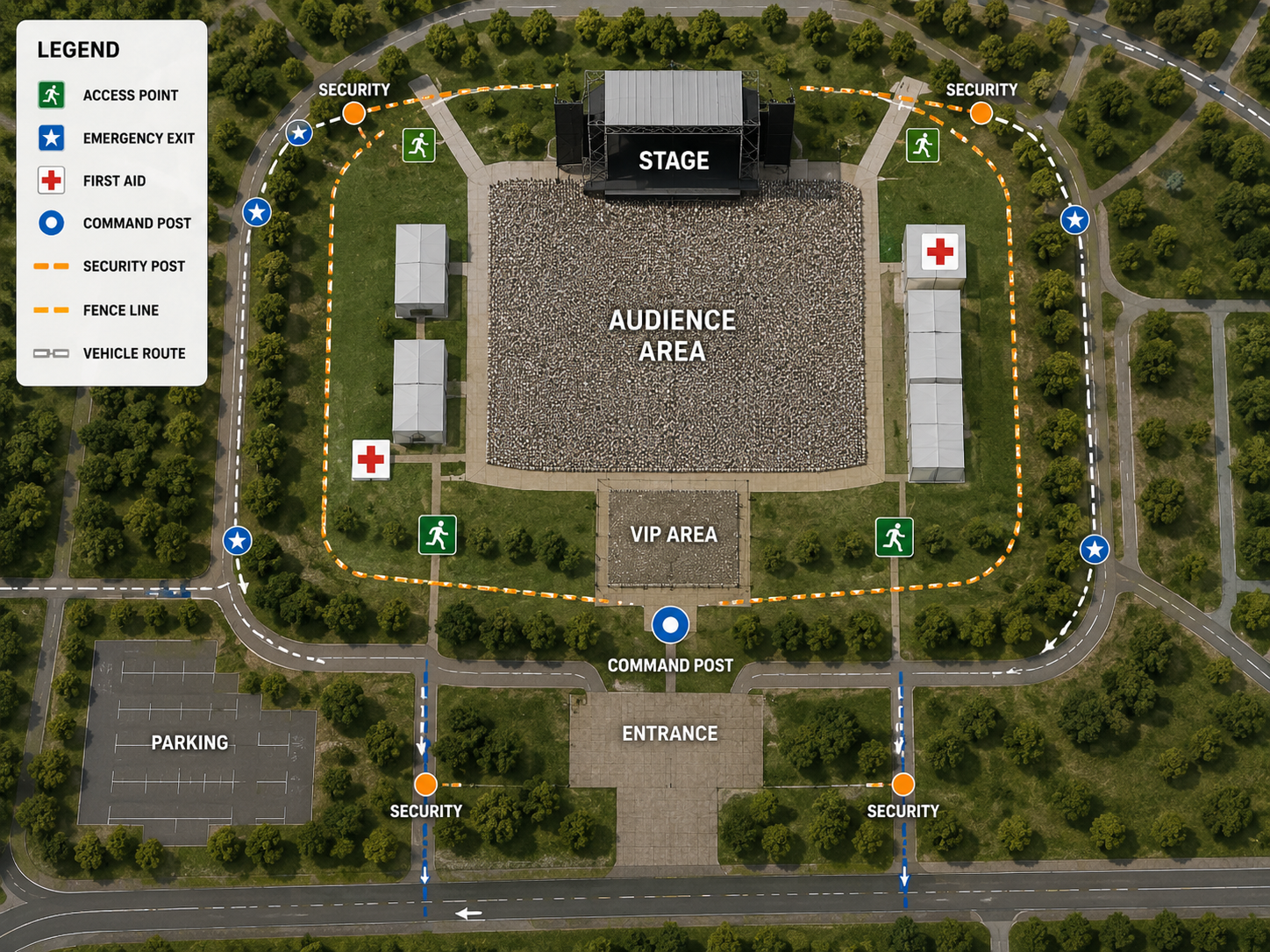
Security planning is executed by converting threat scenarios and identified vulnerabilities into a structured Event Security Plan, supported by a Security Requirements Estimate (SRE), defined command and control structure, and coordinated operational measures.
All outputs shall ensure:
- alignment with organizational and host authority frameworks
- integration of access control, accreditation, and movement control
- coordination of emergency response, VIP protection, and medical support
- execution, monitoring, and accountability
- traceable and auditable security decisions
The final output is a controlled, layered, and executable Event Security Plan that supports operational deployment and decision-making.
Capability Development Chain
Event → Threat Scenario → Vulnerability → Risk → Security Measures → SRE → Event Security Plan → Deployment → Control → Output
Participants shall
assess event exposure
determine feasibility based on risk
define layered security measures
structure command and control
allocate resources
produce executable plan
Key Concepts
- Translate event-specific threat scenarios, vulnerabilities, and risk into a structured Event Security Plan
- Apply Host Country coordination to define responsibilities, control boundaries, and operational integration
- Assess event exposure and determine feasibility based on threat, risk, and operational conditions
- Develop and manage Security Requirements Estimates (SRE) to define required personnel, equipment, and capability
- Structure command, control, and communication to ensure operational authority, coordination, and decision flow
- Design layered security systems using defence-in-depth, integrating perimeter, access control, screening, and internal security
- Implement access control, accreditation, and screening systems to regulate movement and prevent unauthorized access
- Define and coordinate emergency response, fire safety, medical support, and crisis management measures
- Integrate VIP and Close Protection operations within controlled event security structures
- Develop and enforce SOPs, post orders, and deployment plans to ensure consistent execution
- Monitor and control live operations, identify deviations, and apply corrective actions
- Validate operational feasibility of all measures under routine and crisis conditions
- Capture incidents, assess performance, and define corrective actions through structured after-action processes
- Maintain traceability and accountability across planning, execution, and review cycles
MODULE 1: EVENT QUALIFICATION & TRIGGER+
Purpose
Determine when special event security process is required.
Learning Outcomes
identify event characteristics requiring enhanced security
determine exposure level (visibility, participants, threat relevance)
verify trigger conditions for special event planning
justify classification as Special Event / Major Event
Key Exercises
assess multiple event scenarios
determine trigger threshold
justify classification decision
MODULE 2: EVENT-SPECIFIC THREAT & RISK INPUT+
Purpose
Define security baseline using SMART outputs.
Learning Outcomes
identify threat scenarios affecting event
assess vulnerabilities (venue, participants, environment)
determine event-specific risk levels
verify feasibility of event execution
justify go / no-go recommendation
Key Exercises
map threat scenarios to event conditions
identify critical vulnerabilities
produce feasibility decision
MODULE 3: HOST COUNTRY COORDINATION+
Purpose
Define external security responsibility and control boundaries.
Learning Outcomes
identify host authority capabilities and responsibilities
define security control boundaries (inner vs outer)
establish coordination structure
verify alignment between organizational and host capabilities
justify required support levels
Key Exercises
map responsibilities (internal vs external)
define control zones
identify coordination gaps
MODULE 4: SECURITY CONCEPT & DEFENCE-IN-DEPTH+
Purpose
Establish layered security system.
Learning Outcomes
design layered security (Blue / Red / Outer / Area of Interest)
assign functions to each layer (deter, detect, delay, respond)
identify gaps between layers
verify redundancy and overlap
justify layer design
Key Exercises
build 4-layer security model
assign measures per layer
identify weak points
MODULE 5: VENUE SECURITY ASSESSMENT+
Purpose
Determine if venue supports risk-controlled operations.
Learning Outcomes
assess perimeter exposure
evaluate access routes and choke points
identify environmental risks
verify evacuation feasibility
justify venue suitability
Key Exercises
conduct venue security assessment
compare multiple venues
produce selection recommendation
MODULE 6: SECURITY REQUIREMENTS ESTIMATE+
Purpose
Define required capability to implement measures.
Learning Outcomes
identify required personnel by function
identify required equipment per security layer
determine infrastructure needs
verify alignment with risk level
justify resource requirements
Key Exercises
build full SRE from scenario
calculate personnel deployment
identify capability gaps
MODULE 7: EVENT SECURITY PLAN STRUCTURE+
Purpose
Convert analysis into executable plan.
Learning Outcomes
define mission based on risk
structure plan (Situation → Execution → Control → Support)
integrate SMART outputs into plan
assign responsibilities
justify planning decisions
Key Exercises
build full Event Security Plan
map measures into plan structure
validate traceability
MODULE 8: PERIMETER & ACCESS CONTROL OPERATIONS+
Purpose
Control entry and prevent unauthorized access.
Learning Outcomes
design perimeter control system
define access control points (pedestrian / vehicle)
determine screening requirements
identify throughput vs security balance
justify access control design
Key Exercises
design entry layout
assign screening resources
identify bottlenecks
MODULE 9: INTERNAL SECURITY & MONITORING+
Purpose
Maintain control inside secured area.
Learning Outcomes
define internal patrol and coverage
assign monitoring systems (CCTV, SOC, JOC)
identify critical areas requiring control
verify detection capability
justify monitoring structure
Key Exercises
map internal coverage
define SOC/JOC roles
identify blind spots
MODULE 10: COMMAND, CONTROL & COMMUNICATION+
Purpose
Ensure operational control and decision flow.
Learning Outcomes
define command structure
assign operational roles
establish escalation procedures
define communication channels
justify command model
Key Exercises
build command structure
simulate decision escalation
define communication plan
MODULE 11: EMERGENCY & CRISIS RESPONSE+
Purpose
Ensure response capability beyond routine operations.
Learning Outcomes
identify crisis triggers
define response procedures (evacuation, lockdown, extraction)
assign crisis roles (strategic vs operational)
verify integration with external responders
justify response design
Key Exercises
simulate emergency scenarios
define response flow
validate coordination
MODULE 12: VIP / EXECUTIVE PROTECTION INTEGRATION+
Purpose
Secure high-profile individuals within event environment.
Learning Outcomes
identify VIP threat levels
determine protection requirements
define movement control
verify integration with event security
justify protection measures
Key Exercises
build VIP movement plan
assign protection resources
identify vulnerabilities
MODULE 13: IMPLEMENTATION & OPERATIONAL CONTROL+
Purpose
Execute plan under operational conditions.
Learning Outcomes
deploy personnel based on plan
enforce SOPs and post orders
monitor real-time operations
identify deviations
justify corrective actions
Key Exercises
simulate live deployment
identify operational failures
apply corrections
MODULE 14: POST-EVENT CONTROL & ACCOUNTABILITY+
Purpose
Capture performance and ensure improvement.
Learning Outcomes
document incidents
evaluate effectiveness of measures
identify failures and gaps
define corrective actions
justify improvements
Key Exercises
produce after-action report
identify lessons learned
define improvements
MODULE 15: FINAL OPERATIONAL SCENARIO+
Purpose
Validate full capability chain under pressure.
Conditions
incomplete intelligence
multi-agency coordination
time constraints
VIP presence
evolving threat
Required Output
full Event Security Plan
Sre
command structure
deployment plan
acceptable risk recommendation
Assessment Requirements
Event Threat & Risk Input
Venue Security Assessment
Sre
Event Security Plan
Command Structure
Deployment Plan
Crisis Response Plan
After-Action Report
Need help choosing the right training?
Tell us the role, capability, or operational requirement you need to address.
Apply for this course.
Submit your course selection and applicant details. Supporting documents are requested separately after review.
Need this capability across an organization or public-service unit?
We adapt course scope, scenarios, delivery, and assessment to your staff, mandate, and operating environment.